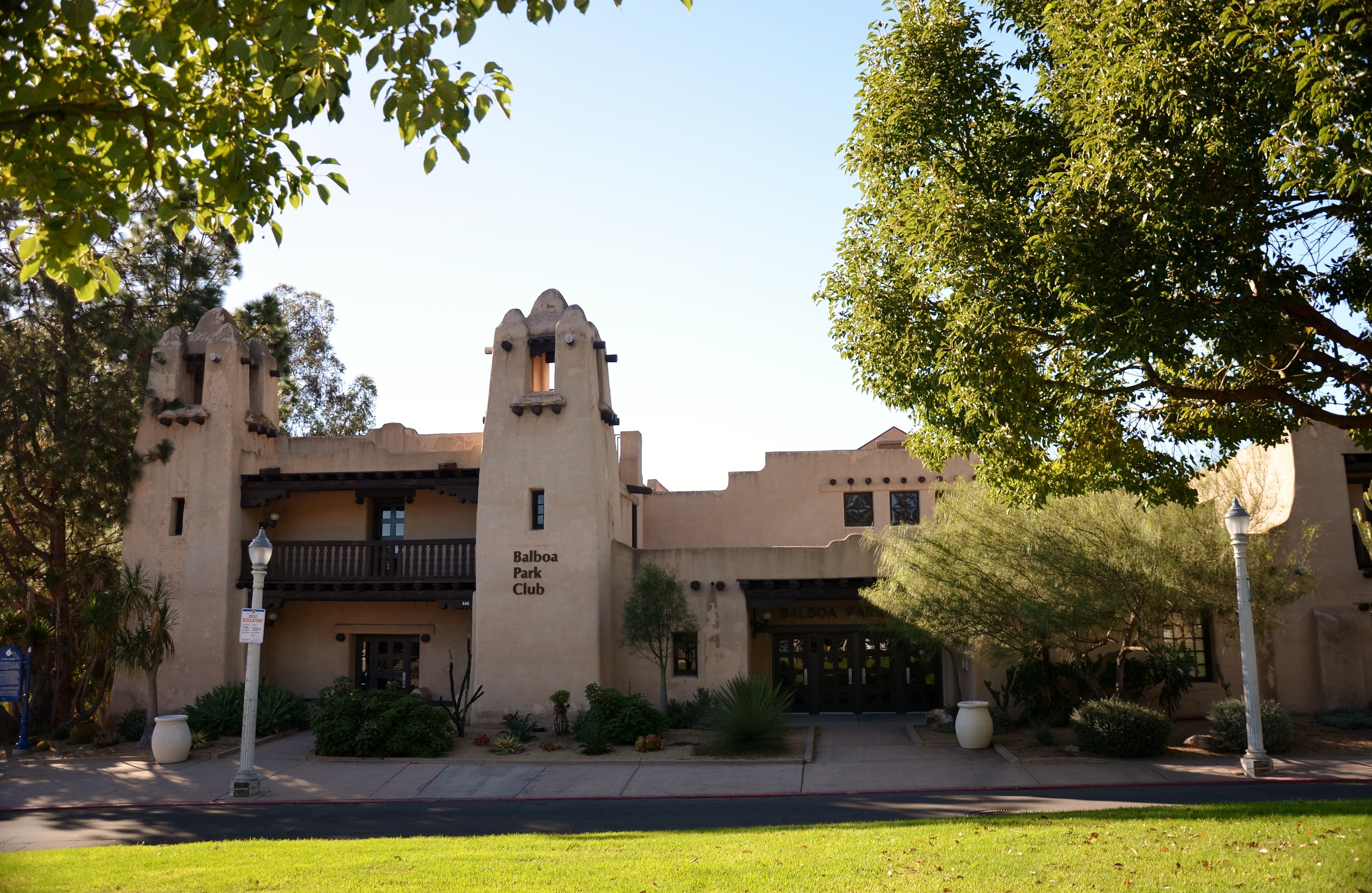
The State of New Mexico built this pavilion for the 1915 Panama-California Exposition, just three years after achieving statehood in 1912 following a sixty-two-year territorial period marked by congressional reluctance about its Hispanic and Indigenous majority population. The brand-new state chose to present itself to the nation through the architecture of its Indigenous pueblos, commissioning Isaac Hamilton Rapp to model the building directly on the mission church of San Estevan del Rey at Acoma Pueblo, built by Acoma people under Spanish direction beginning in 1629. That source building is itself layered history, constructed twenty-eight years after the Acoma Massacre of 1599 and maintained by Acoma Pueblo as a sovereign nation to this day. Richard Requa remodeled the pavilion for the 1935 California Pacific International Exposition as the Palace of Education, after which it became the Balboa Park Club.
The building presents stepped, battered adobe-like massing executed in stucco over frame, with twin bell towers, projecting vigas, deep-set openings, and rounded parapets. This is the one 1915 exposition building that is not Spanish Colonial Revival. It is Puebloan with Spanish mission overlay, and the distinction is the whole point. The interior holds a significant mural by Belle Baranceanu, painted under the New Deal art programs, and the main hall is a substantial and well-proportioned room that serves as a rentable civic space.