
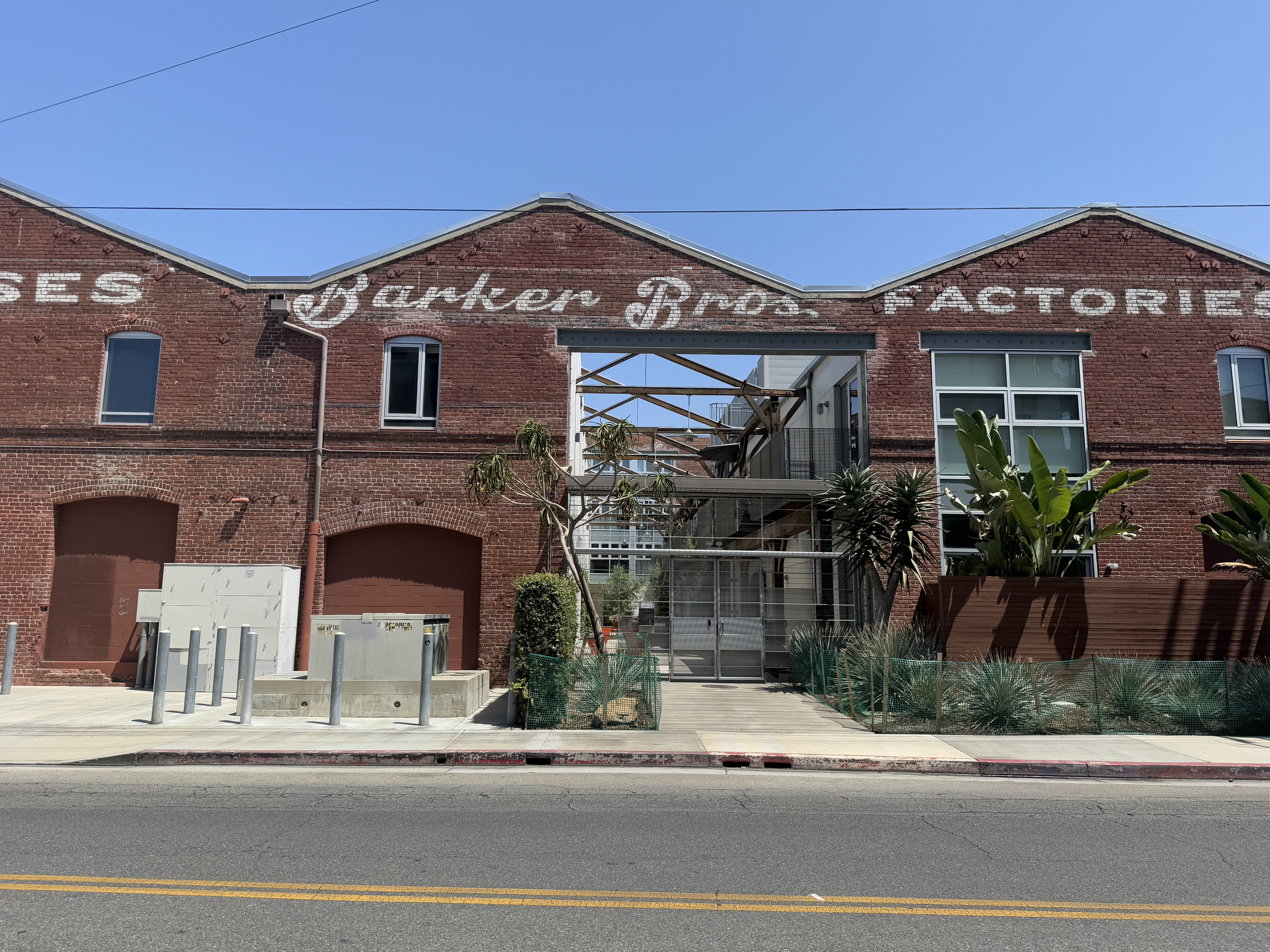
Rising from the industrial eastside during Los Angeles's explosive 1920s growth, the Barker Brothers warehouse materialized as part of a vast commercial empire serving the region's booming furniture trade. Barker Brothers, which by the mid-1920s advertised itself among the world's largest furniture retailers, commissioned this utilitarian giant to anchor their expanding wholesale operations in what would become the Arts District. The warehouse embodied a period when Los Angeles was rapidly scaling its industrial infrastructure to serve a metropolitan population hungry for goods and furnishings. Built to support the city's increasingly sophisticated network of rail freight, trucking, and distribution, the structure represented the machine-age economy transforming downtown's eastern periphery.
Curlett & Beelman conceived the warehouse as an industrial palazzo, employing classical revival language to dignify commerce and reassure investors in the company's corporate ambitions. The architects wrapped the enormous utilitarian block in rusticated masonry at the lower levels, punctuated by rhythmic arched openings that lent civic gravitas to purely functional space. Thick floor plates and robust structural framing accommodated heavy manufacturing loads, while repetitive industrial windows provided necessary illumination for warehouse operations. The building's loading-oriented logistics and generous proportions would later prove ideal for adaptive reuse, though its original identity remained resolutely corporate-industrial rather than bohemian.