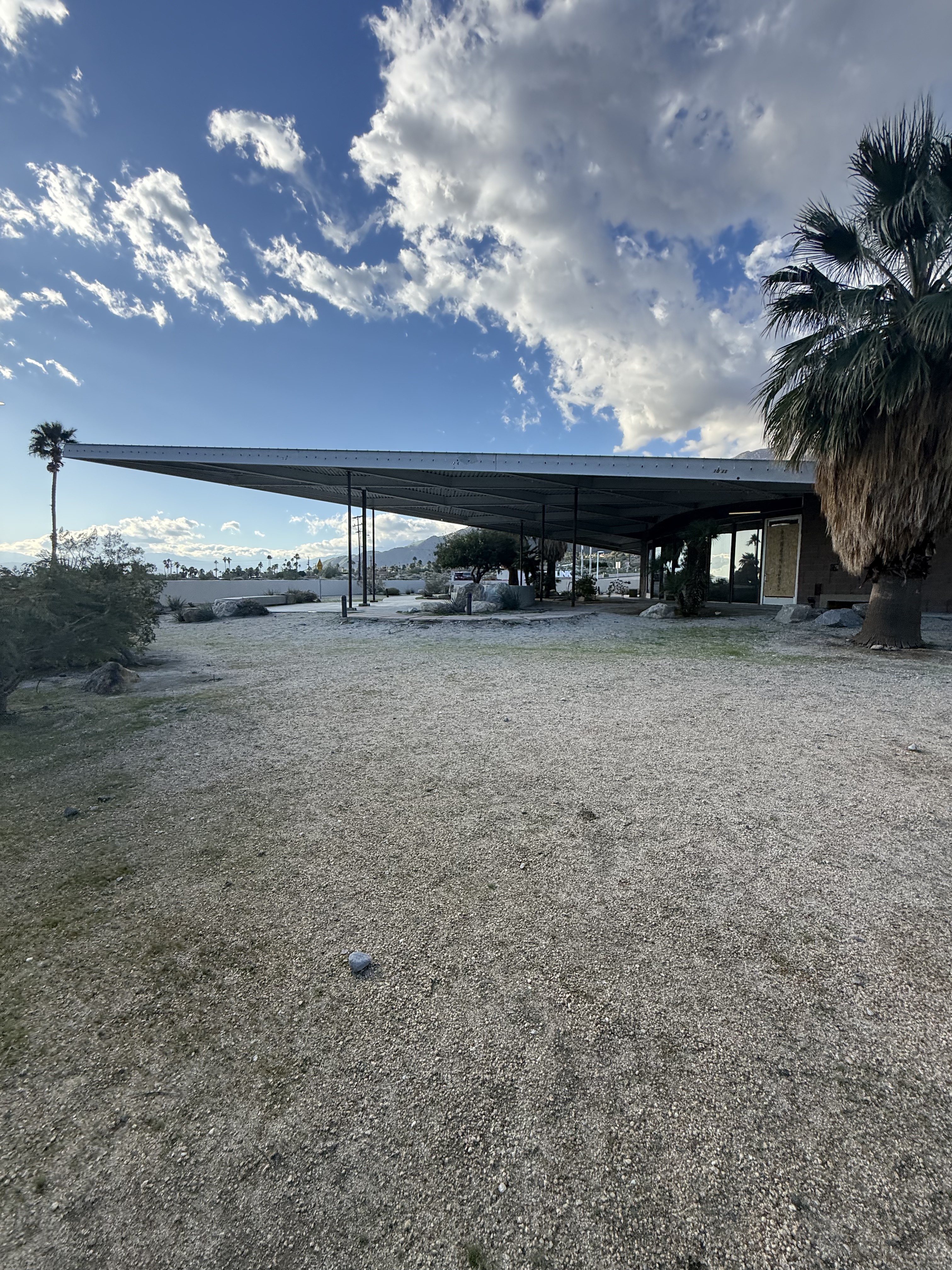
Built in 1963-1965 as an Esso service station for Humble Oil, the Tramway Gas Station was designed by Frey & Chambers to announce arrival in Palm Springs at highway speed. Positioned at the city's north gateway, at the base of the road to the Palm Springs Aerial Tramway, the building functioned during the peak of American car culture, when roadside architecture competed for attention from drivers traveling at 45 miles per hour. The commission arrived during the final years of the Frey & Chambers partnership, after which Albert Frey would continue practicing independently.
The design centers on a hyperbolic paraboloid canopy, a wedge-shaped steel and wood roof that cantilevers dramatically toward the highway in what has become universally known as the "flying wedge." The structure is essentially a sign you can drive under, with a modest enclosed volume beneath an outsized gesture. The canopy demonstrates structural exhibitionism applied by a European-trained rationalist to a quintessentially American building type, transforming a utilitarian gas station into a sculptural landmark.