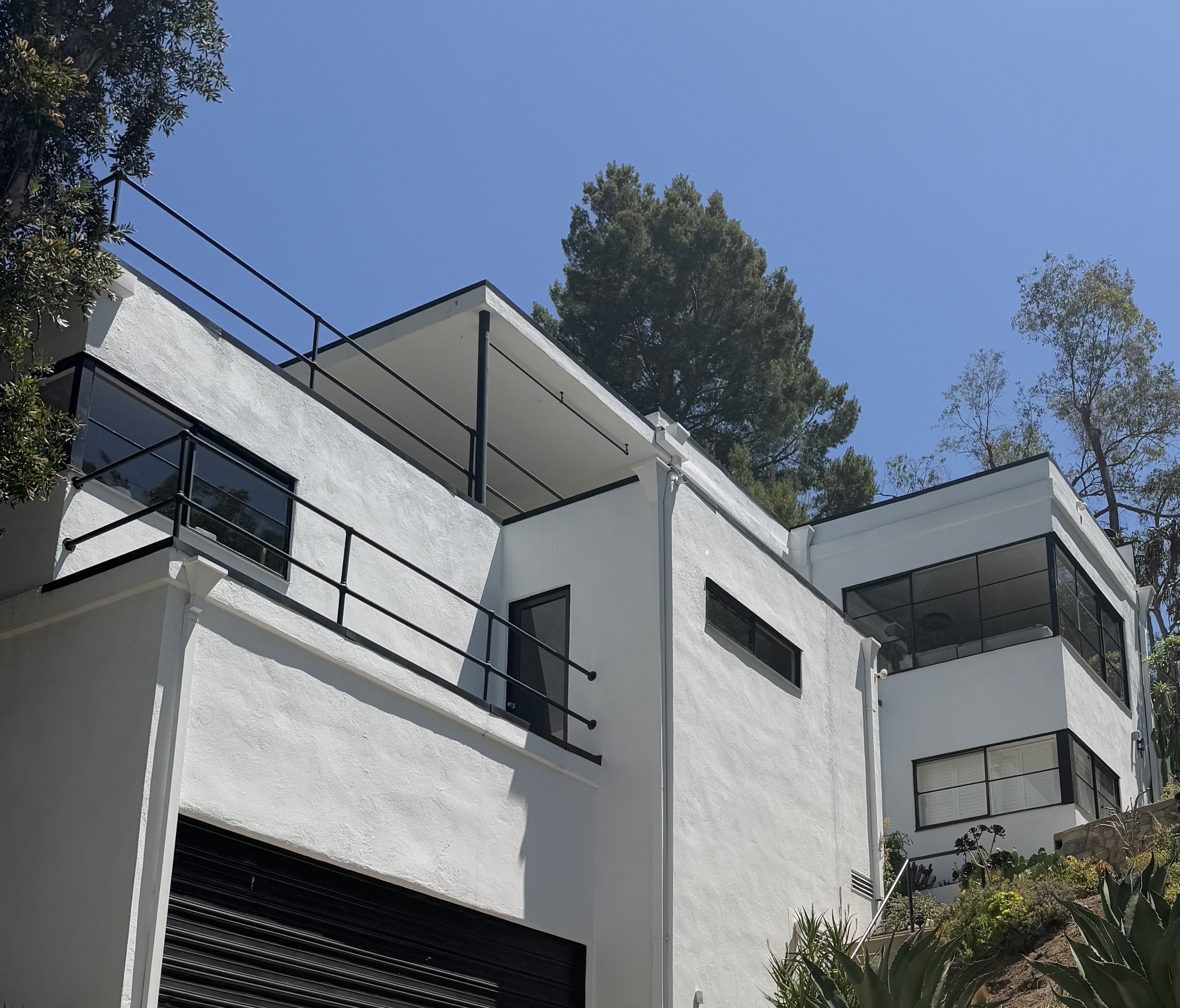
Commissioned by Thomas J. Atol in the late 1930s, this hillside residence stands as one of designer-builder William Kesling's most dramatic expressions of Streamline Moderne architecture adapted to the Arroyo landscape. The house belongs to a moment when Southern California modern design absorbed the aesthetics of speed and technology, translating ocean liner and industrial imagery into domestic form. Its creation story carries an unusual twist: Kesling allegedly coordinated the house's completion while serving time in San Quentin on fraud charges, making this one of the stranger narratives in the region's modern-house canon. Rising on Glen Holly Drive during the final years of the Depression, the residence brought machine-age glamour to a steep Pasadena site already attracting experimental architecture.
The design steps down the slope in three terraced levels, with a comparatively restrained street facade giving way to open downhill elevations defined by broad horizontal bands and generous decks. Curving corners, metal railings, and ribbon-like glazing create the signature "steamliner" character, while the dramatic elevated deck reinforces the nautical associations central to Streamline Moderne vocabulary. Light-frame construction adapts to the challenging topography without the steel experiments of larger International Style houses, demonstrating Kesling's builder's pragmatism. The reverse floor plan takes advantage of downhill views, and recent updates to roof, plumbing, and electrical systems, along with solar installation, maintain the underlying logic of Kesling's original conception.