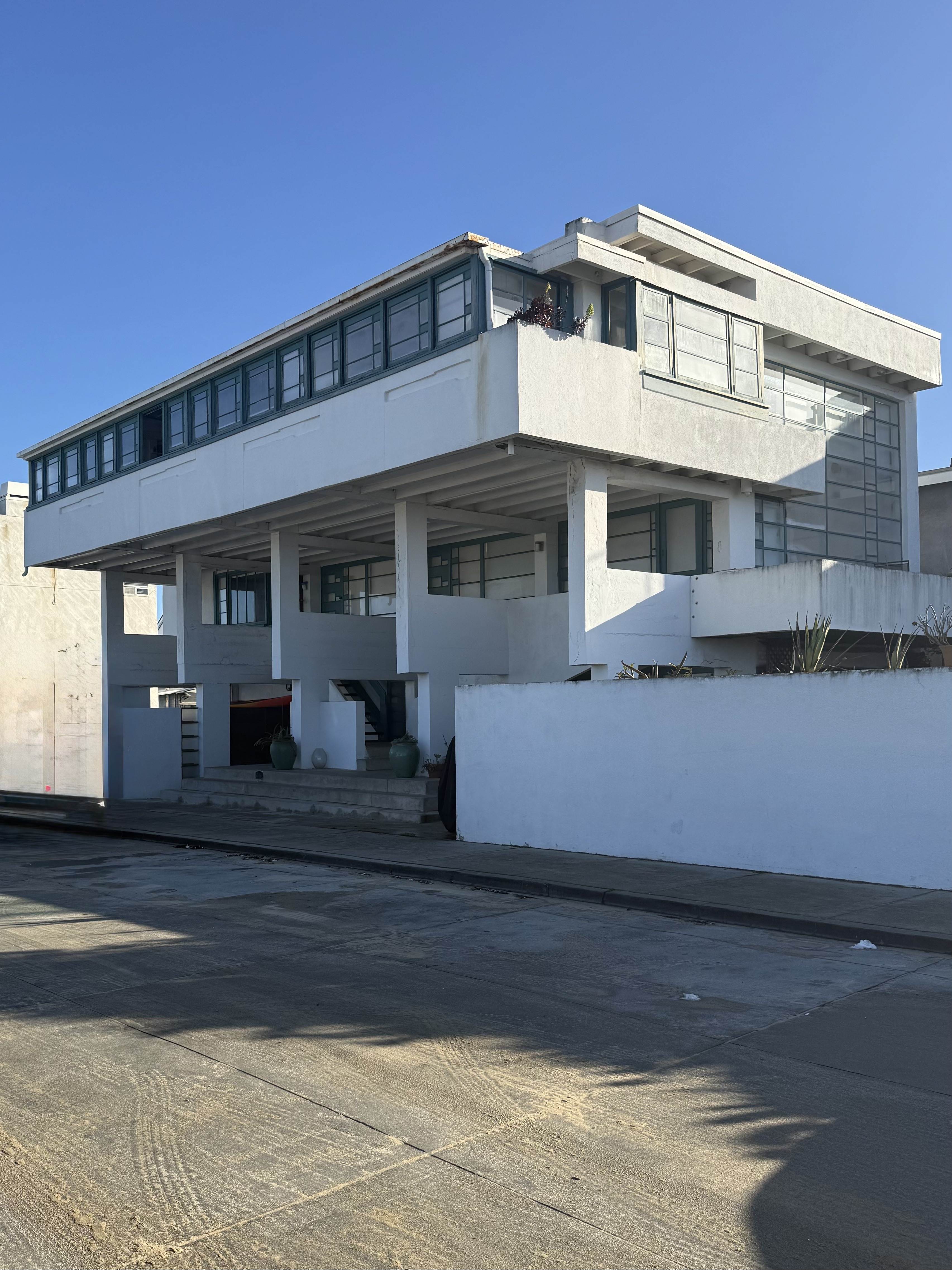
Completed in 1961 for the Coachella Valley Savings & Loan Association, this building anchors the south end of what was Palm Springs' postwar financial district, a quarter-mile stretch of South Palm Canyon Drive where four institutions competed openly on architecture. The brief called for something sculpturally monumental, seismically safe, and highly functional. It was the association's second commission from the same architect, six years after a white Corbusian box on piloti a few blocks north, and this time the client got a monument instead of a branch.
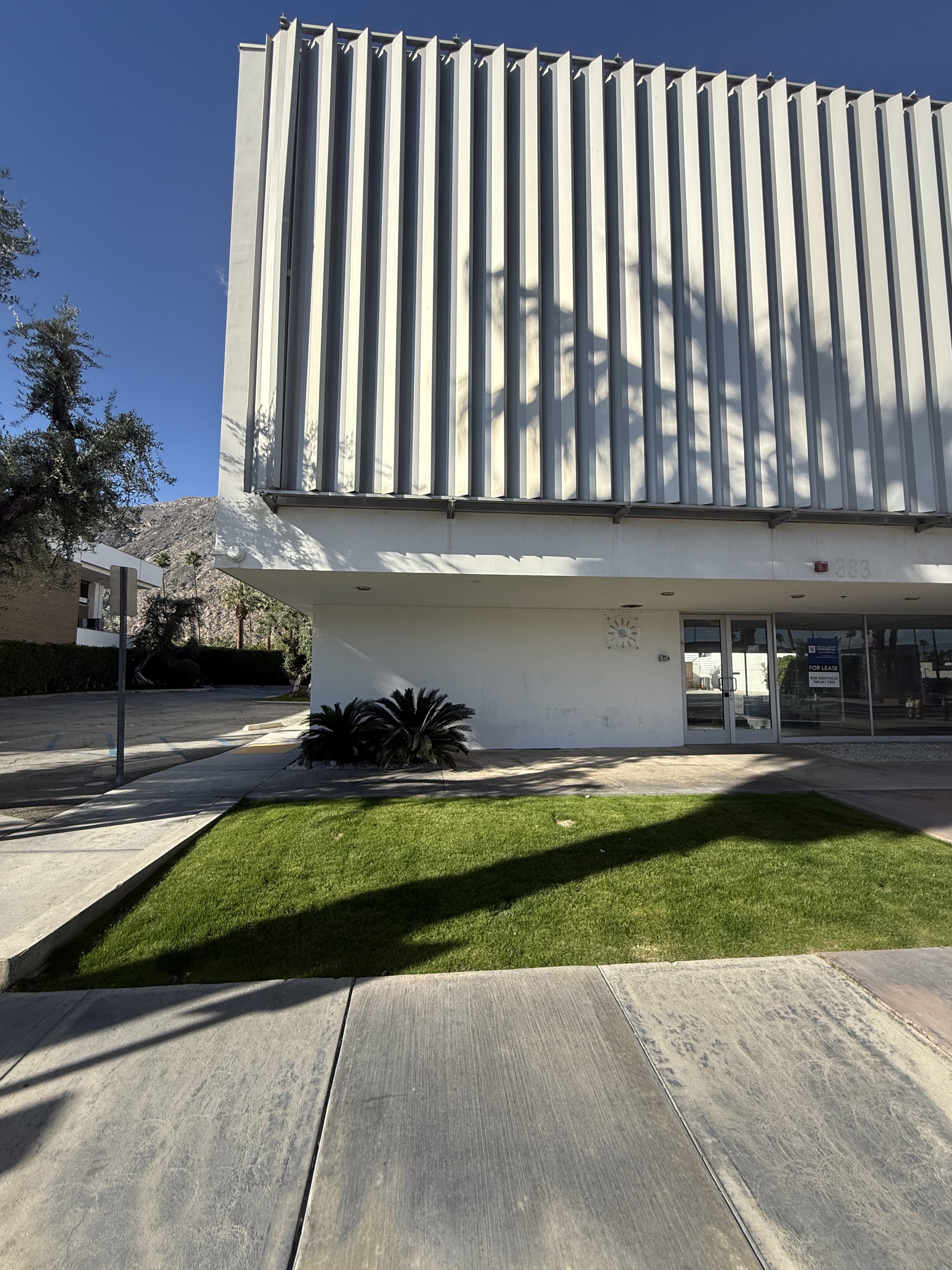
The signature move is the row of inverted arches on the east elevation: reinforced concrete forms that touch down narrowly at the base, flare upward, and taper into columns attached to projecting horizontal T-beams that carry the flat roof. The arches widen at the bottom for seismic stability, so the ornament is also the lateral bracing. Behind them the building is wrapped in an anodized ribbed aluminum skin, with clerestory windows at the top and shallow windows at floor level. The roof is precast concrete with post-tensioned T-beams spanning ninety feet across the first-level banking floor, and the mezzanine floor is hung from the ceiling structure rather than supported from below, which keeps the banking floor completely column free. A full-width reflecting pool with fountains runs along the street frontage and continues underneath the cantilevered terrazzo floor slab where the arches meet the ground. At night, with uplit fountains and recessed lighting behind the arches, the mass reads as floating on water. The ten-foot grade variance on the parcel was solved with a split-level reinforced concrete parking structure at the rear with customer entrances on two levels, one leading down to the main lobby and one to the mezzanine above.