
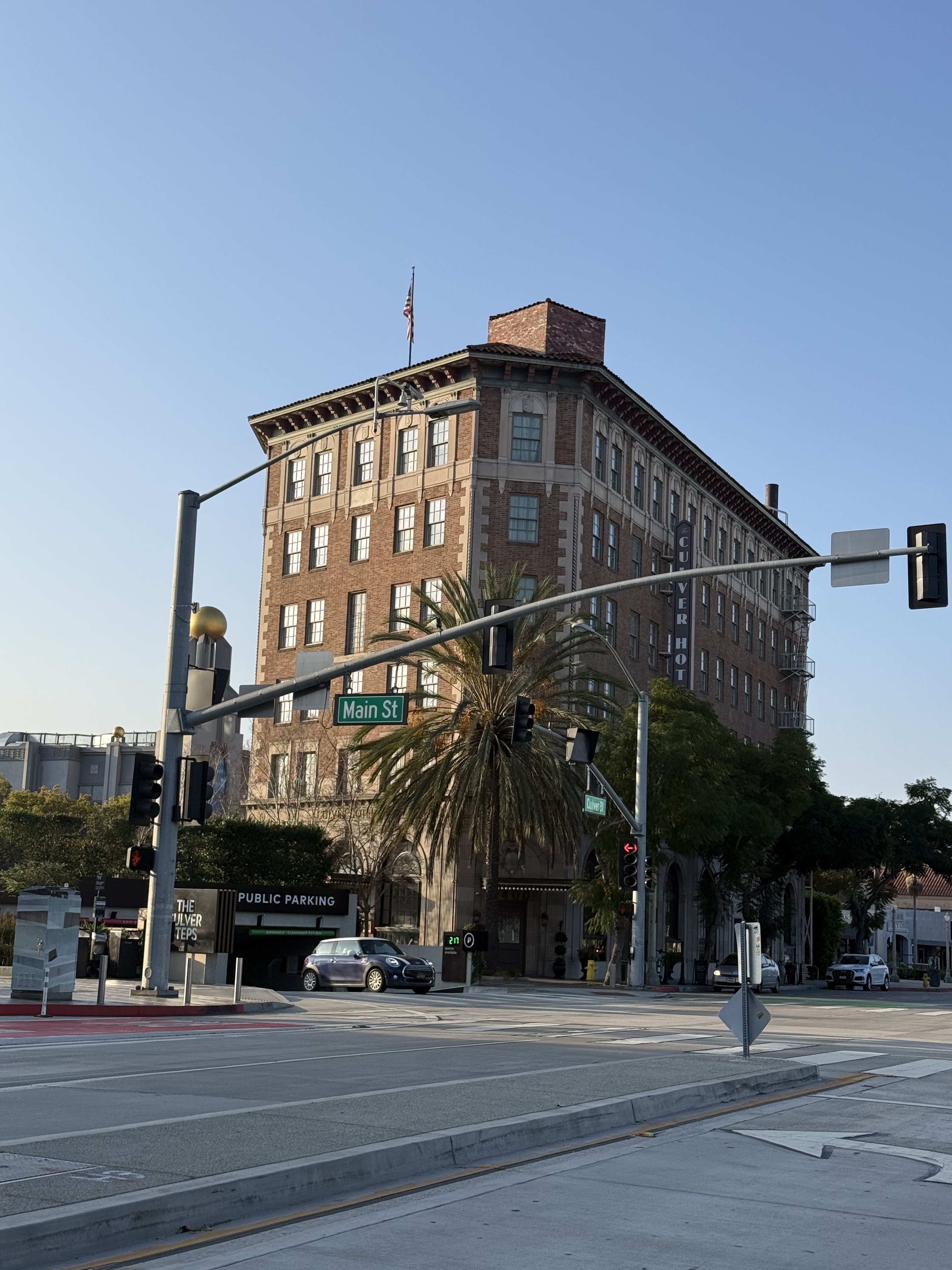
Harry Culver commissioned this wedge-shaped hotel in the 1920s as both headquarters and symbol for his ambitious vision of Culver City. The developer understood that a young municipality needed monumental architecture to establish instant legitimacy, particularly one positioning itself as the "Heart of Screenland." Curlett & Beelman designed the structure to serve dual purposes: a practical hospitality venue for the burgeoning film industry and a civic landmark that would put Culver City on the map. The building belongs to the booster era of independent Los Angeles municipalities, when speculative developers used grand architecture to transform agricultural land into legitimate urban centers.
The architects converted a challenging triangular site into architectural advantage, creating a compact vertical form that functions as a small-town skyscraper. Sculpted stone and brick surfaces define the Beaux-Arts facade, while regular window rhythms and a strong cornice line provide classical order to the unconventional geometry. Like New York's Flatiron Building, the pointed form makes the structure instantly memorable, turning urban constraint into branding opportunity. Interior spaces retain much of their historic atmosphere despite multiple alterations and restorations that have adapted the building for contemporary hospitality use.