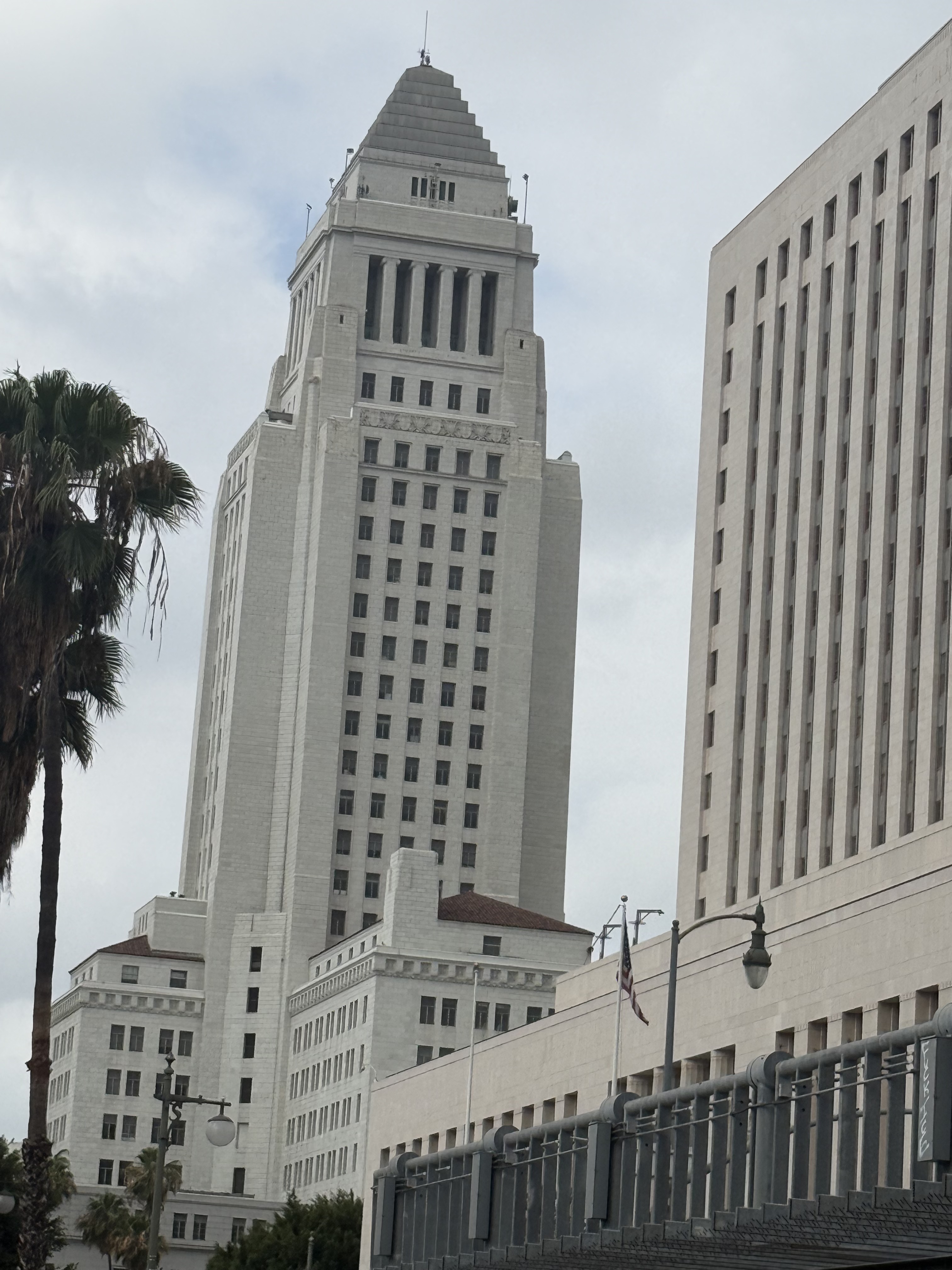
The City of Los Angeles commissioned this 32-story civic skyscraper in the 1920s during an era of unprecedented municipal ambition, when annexation, oil wealth, and regional boosterism demanded a symbol worthy of the city's metropolitan aspirations. Completed in 1928, the building represented Los Angeles at the height of interwar expansion, when the sprawling city sought to present itself as a disciplined world metropolis capable of commanding respect on the national stage. The collaborative design emerged from three major practitioners: John Parkinson handled the overall architectural concept, Albert C. Martin managed structural engineering, and John C. Austin oversaw working drawings and administration. This cooperative effort produced a monument that would anchor the Civic Center and establish the visual vocabulary of governmental authority for generations.
The tower's tripartite massing fuses Beaux-Arts planning principles with early Art Deco verticality and monumental classicism, creating setbacks that emphasize the building's dramatic ascent above the downtown plateau. Granite and terra-cotta cladding wraps the exterior in materials that convey both permanence and refinement, while the commanding central tower creates an unmistakable skyline marker that dominated the pre-war urban fabric. The concrete structure incorporates sand from each of California's counties and water from the state's historic missions, a piece of civic mythmaking that transforms construction materials into symbols of statewide unity. Interior spaces maintain the same monumental character, with public halls and chambers designed to inspire civic reverence through scale and material richness.