The Archdiocese of Los Angeles commissioned St. Vincent de Paul Catholic Church in the mid-1920s, with construction essentially underwritten by oil tycoon Edward L. Doheny and his wife Carrie Estelle, whose Chester Place estate stood directly behind the site. Albert Carey Martin Sr., a devout Catholic who considered the church his masterwork, designed the building as Los Angeles's supreme statement of Spanish Colonial and Churrigueresque revival. The church was dedicated in 1925 at the height of the Adams District's ecclesiastical building boom, even as its patron faced trial in the Teapot Dome scandal. The opulent commission served simultaneously as an expression of Doheny piety and an ambitious attempt at image repair during the era's defining corruption case.
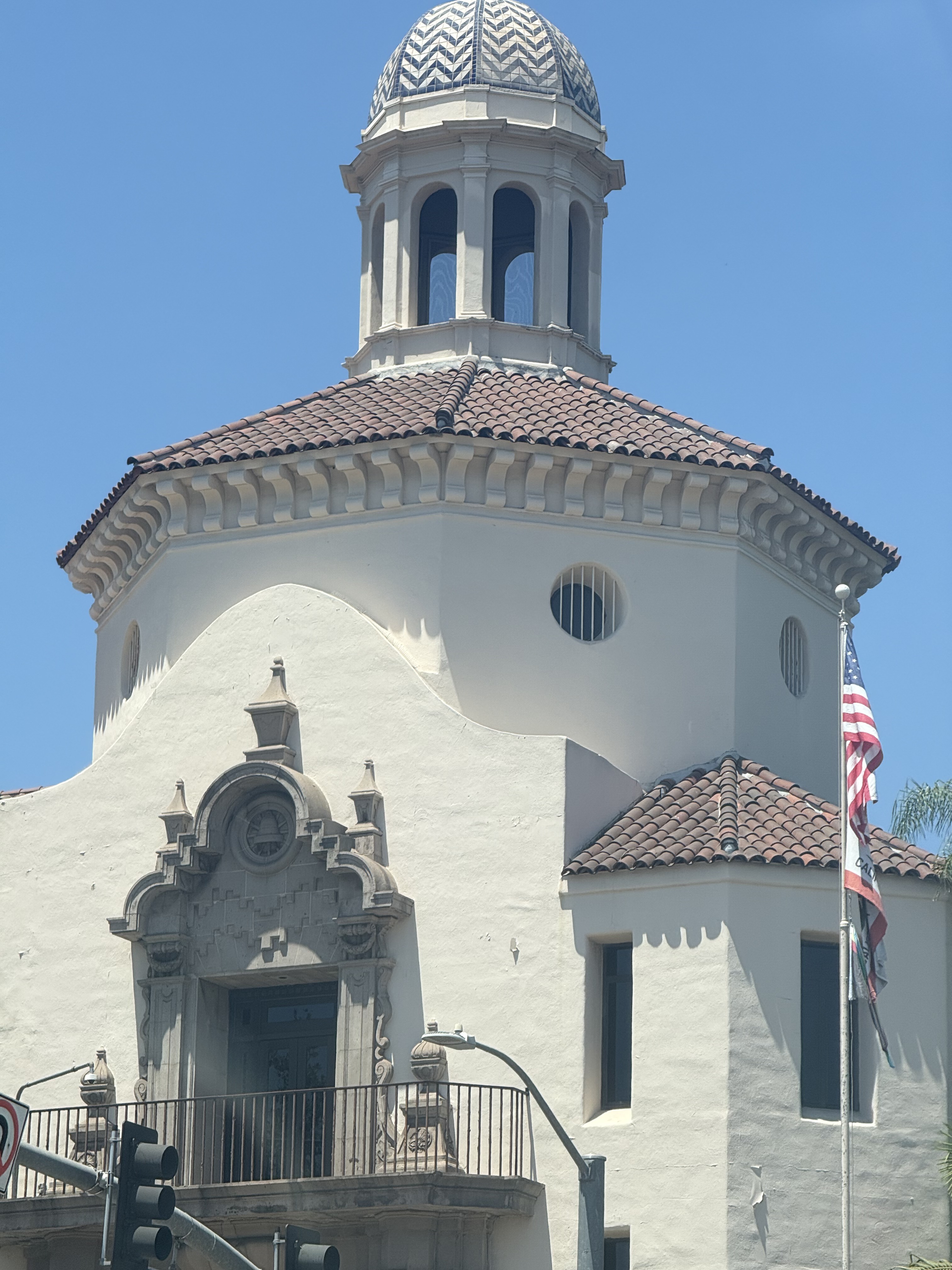
The reinforced-concrete church presents an entrance facade that erupts with cast-stone ornament in the manner of 18th-century Mexican baroque, drawing directly from the churches of Taxco and Mexico City. A polychrome-tiled dome crowns the composition, while a tall tower sits diagonally at the Figueroa corner, addressing both streets and tuned to be visible from the Doheny gate. The interior carries painted and gilded ceilings, stenciled decoration executed by leading ecclesiastical craftsmen, and an elaborate retablo-style altar that completes the Mexican baroque program. Every surface reflects the collaboration between structural innovation and historical revivalism that defined Martin's unique architectural approach.