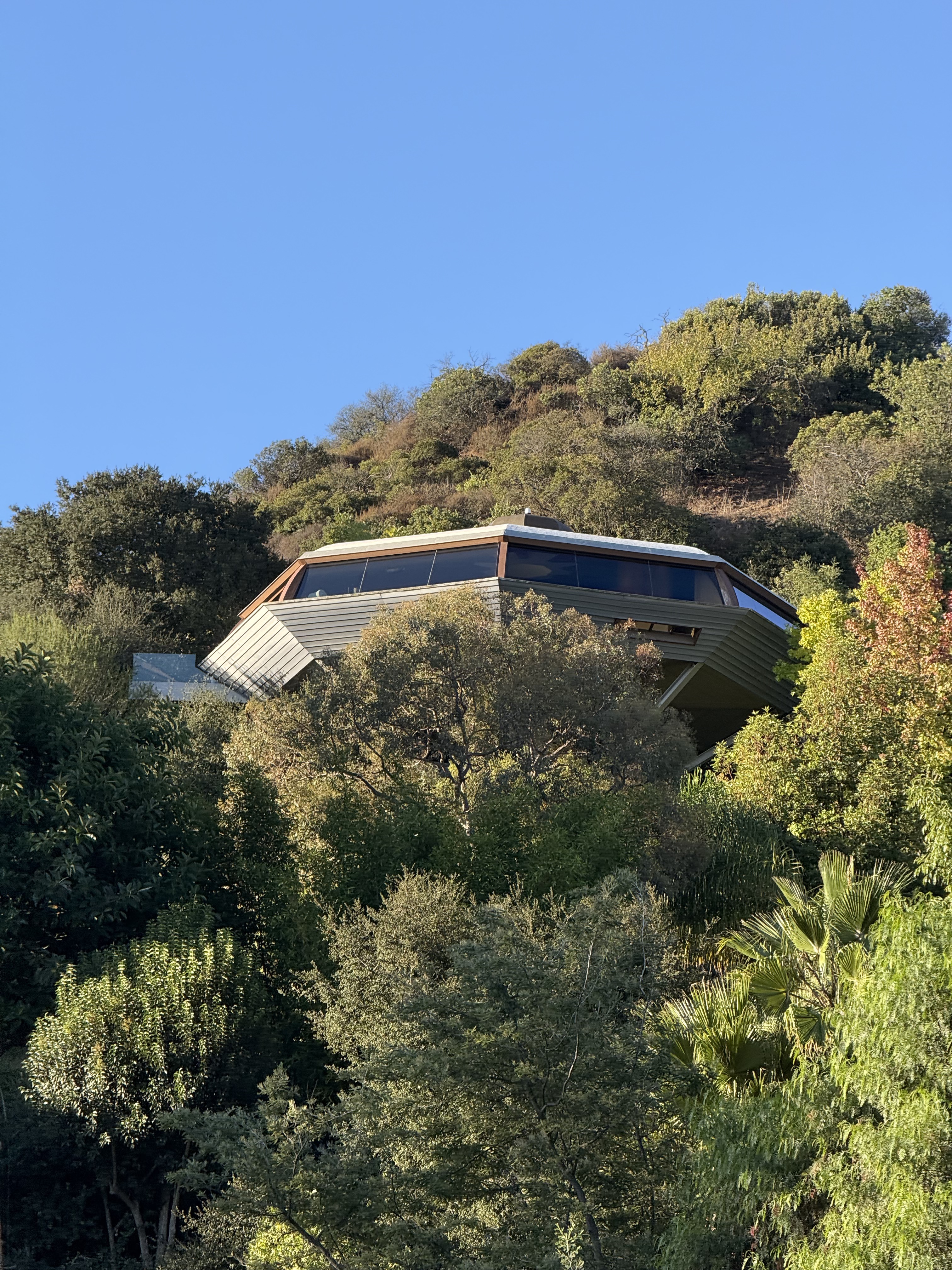
Leonard Malin, a young aerospace engineer, commissioned this radical experiment in domestic architecture during the height of Cold War optimism in 1960. Working with an apparently unbuildable steep Hollywood Hills site and a modest budget, the project required innovative thinking about structure and inhabitation. Material sponsorships from companies like Chem Seal helped realize the ambitious design and provided the house with its memorable name. The residence emerged as one of the most striking architectural expressions of aerospace-age Los Angeles, when experimental materials and futuristic optimism saturated the domestic imagination.
The house presents one of architecture's most succinct structural concepts: an octagonal living pod balanced on a single concrete column rising from the hillside. This steel-framed dwelling features expansive glass walls that maximize panoramic views while wood-lined interiors provide warmth against the technological aesthetic. The visible support system creates an astonishingly legible relationship between the buried foundation, central stem, and hovering octagonal volume. The transparent walls and geometric form produce a space-age image that transforms the challenging topography into an advantage, creating a hovering observatory above the city.