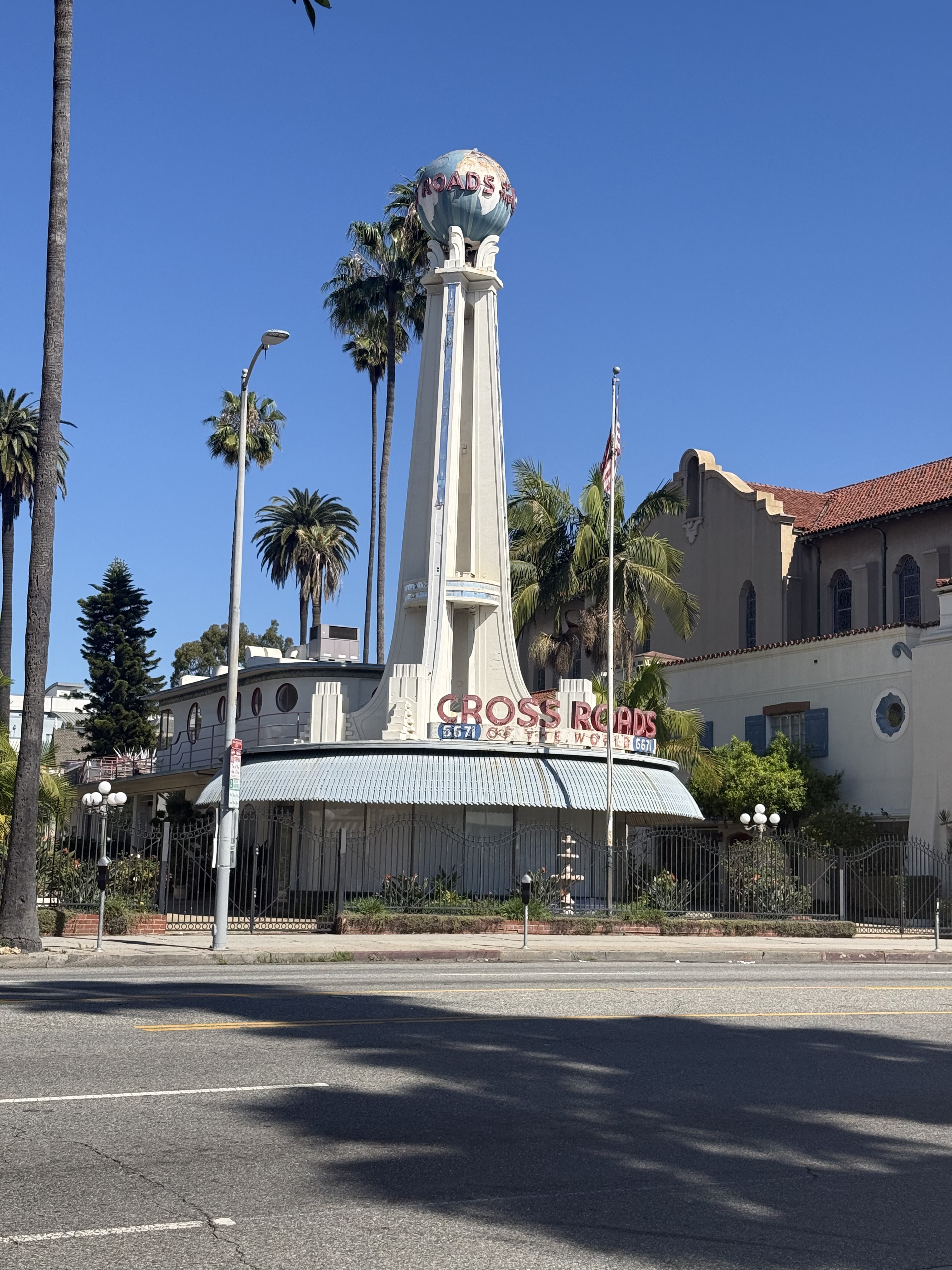
Built in 1936 during Hollywood's golden age, Crossroads of the World was conceived as an upscale cosmopolitan retail destination that would bring global sophistication to the entertainment capital. Robert V. Derrah designed this pioneering outdoor shopping center as both commercial venture and architectural spectacle, creating one of Los Angeles's most conceptually explicit pieces of retail architecture. The development attracted early tenants tied to fashion, imported goods, and entertainment, establishing its identity as a place where consumption and fantasy intersected. The complex emerged at a moment when Hollywood functioned simultaneously as employment center, tourist destination, and testing ground for new forms of automobile-oriented urbanism.
The architectural composition centers on a dramatic ocean liner-shaped building that serves as the complex's anchor, surrounded by smaller structures executed in a theatrical collage of global and historical styles. Rather than following conventional streetwall organization or enclosed department store models, Derrah created a pedestrian commercial environment designed as a miniature world's fair of themed façades, specialized signage, and integrated landscaping. Each structure adopts different stylistic references, creating an eclectic assemblage that functions as both roadside spectacle and proto-lifestyle center. The spatial logic emphasizes visual variety and cinematic composition, with buildings arranged to create scenic vignettes throughout the pedestrian experience.