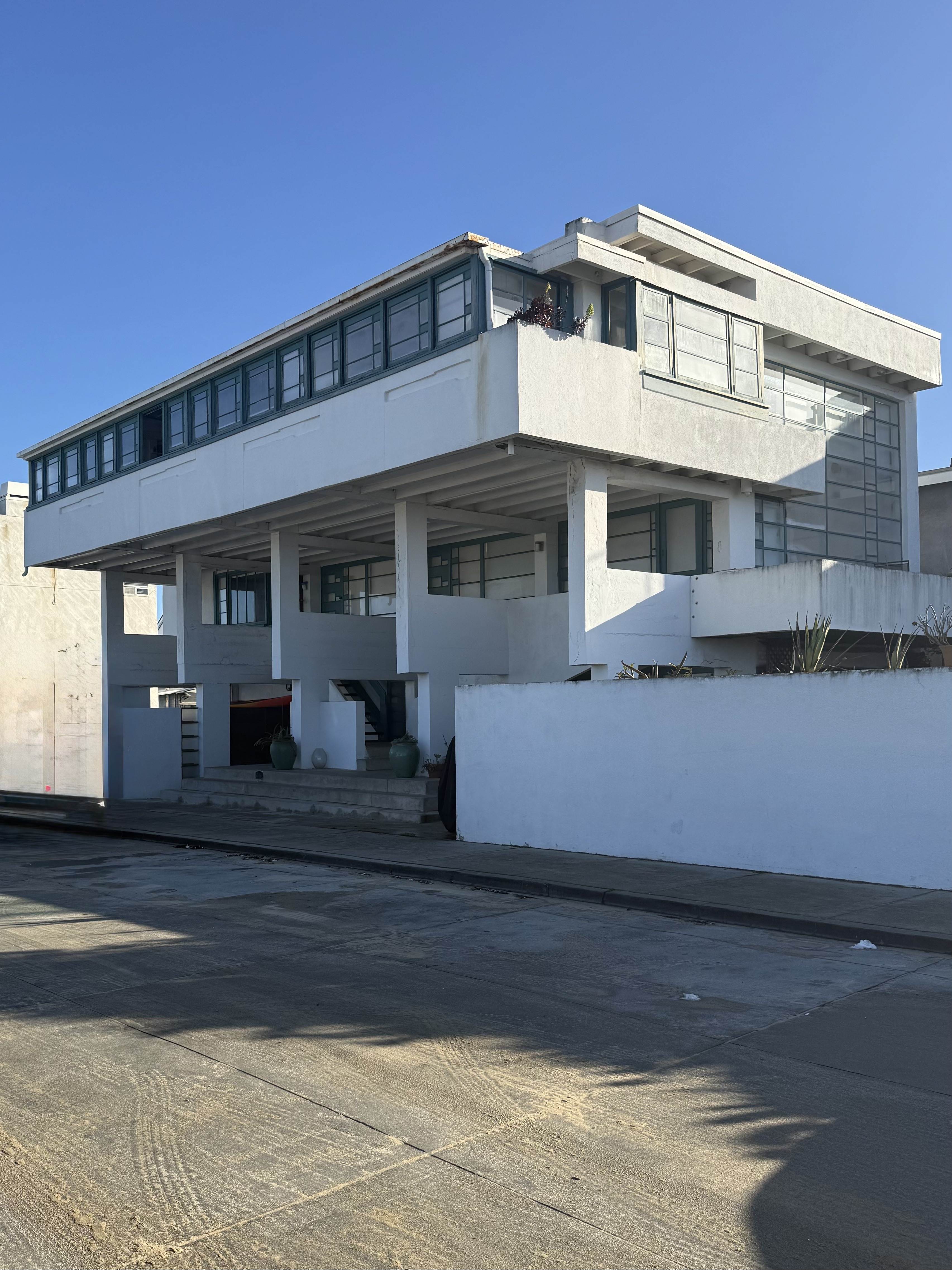
The Lovell Health House was an extraordinary partnership between Richard Neutra and Dr. Philip Lovell, a naturopath and Los Angeles Times health columnist whose obsession with wellness would drive one of residential architecture's most radical experiments. Built between 1927 and 1929, this steel-framed house represented a complete departure from traditional residential construction, applying industrial building techniques to domestic architecture when such methods were virtually unheard of in American homes. When no residential contractors would accept the challenge of working with commercial steel framing, Neutra took on the unprecedented role of both architect and general contractor, marshaling a workforce of seventy men and deploying scaffolding systems typically reserved for skyscrapers. The ambitious project required a 200-foot wooden chute to channel concrete from the hilltop mixing area down to the construction site, while the final cost of $58,672.32 marked it as an exceptionally expensive residence for its era.
The three-story residence's bold structural expression and innovative steel frame system of open-web joists and four-inch-square posts positioned at precise five-foot intervals creates a rhythmic vertical cadence across the elevation. Horizontal bands of white stucco applied over metal lath wrap the exterior, establishing a striking counterpoint between the building's vertical structural elements and its sweeping horizontal lines. Factory-manufactured window assemblies punctuate this composition, while expansive floor-to-ceiling plate glass windows maximize the connection between interior and exterior spaces. The house appears to defy gravity as it cantilevers away from the steep hillside site, supported by minimal foundations that emphasize the building's dramatic relationship with the landscape. Industrial elements find unexpected residential application throughout, most notably in the creative repurposing of Ford Model-A headlights to illuminate the main stairwell, reflecting a broader philosophy of adapting mass-produced components for domestic use.